Written 16th July 2026
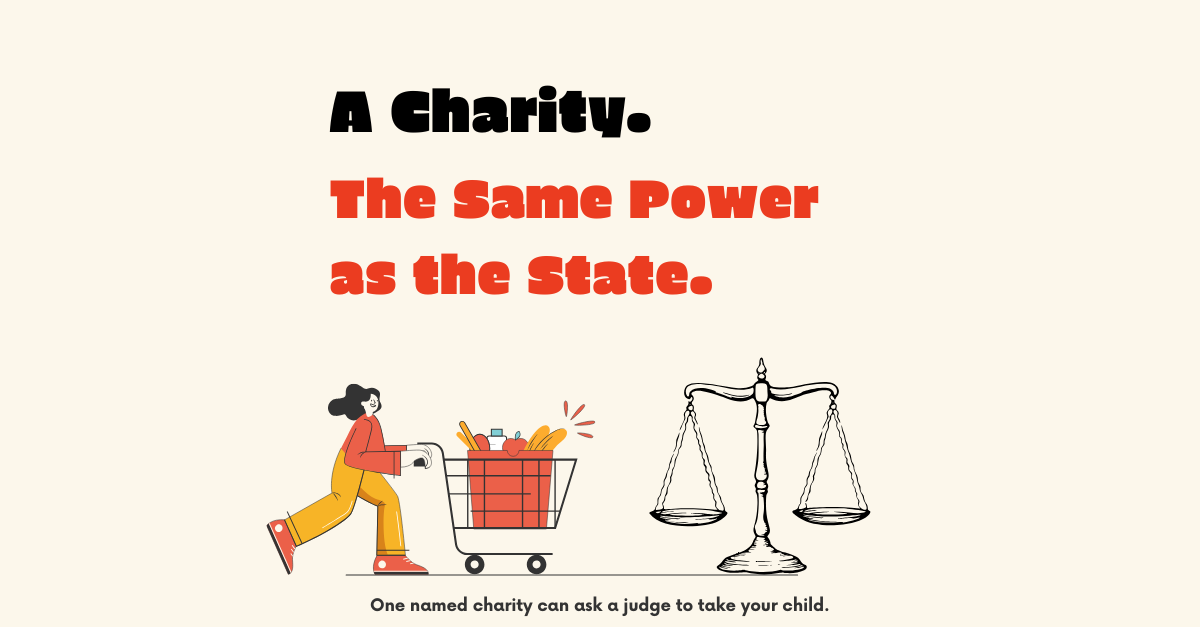
Imagine opening an Act of Parliament and finding a supermarket named inside it. Not “a company authorised by the Secretary of State.” Not “an approved retailer.” Tesco plc, by name, sitting inside a definition section, holding a power ordinarily reserved for the state.
You would assume it was a mistake, or satire, or something from a different, stranger country.
It isn’t hypothetical. It’s already happened. Just not with Tesco.
The actual legislation
Section 31 of the Children Act 1989 sets out who can apply to a court for a care order or a supervision order, the orders that can place a child in the care of a local authority or under its supervision. Under section 31(1), the court may make these orders “on the application of any local authority or authorised person.” Section 31(9) then defines who an authorised person is:
“authorised person” means (a) the National Society for the Prevention of Cruelty to Children and any of its officers; and (b) any person authorised by order of the Secretary of State to bring proceedings under this section and any officer of a body which is so authorised.
Read that again. Paragraph (a) does not say “a charity authorised by the Secretary of State.” It names one specific organisation directly, by its full legal title, ahead of and separate from the general route in paragraph (b). The NSPCC does not need a ministerial order. Its status is written into the statute itself.
This is not new. The NSPCC was an authorised person under the Children and Young Persons Act 1933, and under the 1969 Act it held that status through a ministerial authorisation order. In 1977 the House of Lords described it as the only authorised person under that Act. The Children Act 1989 went one step further and wrote its name into the definition itself.
The same status carries over to emergency protection orders. Any person can apply for one of these under section 44. But section 44(1)(c) gives an authorised person an extra route: the court can make an order where the NSPCC has reasonable cause to suspect a child is suffering, or is likely to suffer, significant harm, it is making enquiries about the child’s welfare, and those enquiries are being frustrated because access to the child is being unreasonably refused. Local authorities have a matching route under section 44(1)(b).
The power is not unlimited. Before applying for a care or supervision order, the NSPCC must, if reasonably practicable, consult the local authority where the child normally lives (section 31(6)). It cannot apply if the child is already the subject of a care or supervision application that has not been decided, or is already subject to certain orders (section 31(7)). And in every case, it is a court that decides.
Still, no other organisation is named in section 31(9). Every other body would need an order from the Secretary of State.
Why this should unsettle you, regardless of how you feel about the NSPCC
This is not an argument about whether the NSPCC does good work. It is a structural argument, and the two things are entirely separate.
Writing a single private institution into the machinery of the state by name is an unusual thing to do. It is not about whether that institution can be trusted today. It is about what it means for one organisation’s role to be fixed in law by name, rather than granted and reviewed like everyone else’s.
Why can a private, unelected organisation be written into an Act of Parliament by name, when a supermarket, a bank or a tech company holding the same status would strike everyone as absurd on sight?
This is not an argument against child protection
None of this is a case against the NSPCC’s work, or against child protection itself. The NSPCC was founded in 1889, and its work protecting children who were being abused has mattered. This is not in dispute, and it should not need repeating in every paragraph to be taken seriously.
But good work does not require a named legal status to continue. A court still has to approve any care order, supervision order or emergency protection order, whoever applies for it. The law already provides a route for other bodies: authorisation by order of the Secretary of State under section 31(9)(b). The objection here is not that the NSPCC intervenes to protect children. It is that one organisation holds by name a status that any other body would have to be specifically authorised to hold.
The NSPCC’s arrangement is unusual. The habit behind it is not.
Once you start looking, the NSPCC turns out to be one of the more restrained examples of a wider pattern: Parliament handing core state functions to private and commercial bodies through narrow statutory provisions.
Private prisons
Section 84 of the Criminal Justice Act 1991 allows the Secretary of State to contract out the running of a prison to a private company. Under section 86, that company’s staff, called “prisoner custody officers,” can search prisoners and people entering the prison, prevent escapes, maintain order and discipline, and use reasonable force where necessary. These are functions ordinarily carried out by state prison officers.
Section 86A, added on 1 November 2007, goes further. At a contracted-out prison, if an officer has reason to believe that someone in the prison or trying to enter it, other than a prisoner, is committing or has committed certain offences under the Prison Act 1952, the officer can require that person to wait for the police for up to two hours, and can use reasonable force to stop them leaving. These are employees of a commercial company, holding a power to restrict a person’s liberty, written into statute. In one sense it is a starker example than the NSPCC: the NSPCC’s power still needs a court’s approval before anything happens, while a prisoner custody officer’s power to hold someone needs no such step in the moment it is used.
Certificated enforcement agents
Private bailiff firms work under the Tribunals, Courts and Enforcement Act 2007, enforcing debts and taking control of goods, a coercive power that can be exercised inside someone’s home. Yet there is no statutory regulator for this industry. Oversight runs through a voluntary body that firms join by choice. More than nine in ten firms have signed up, but none is legally required to. In August 2026, the government announced secondary legislation to bring every firm under that body’s oversight, which campaigners welcomed as a step towards a full statutory regulator. For now, an entire commercial sector with the power to enforce inside people’s homes has been overseen largely because it agreed to be.
Private prosecution, and the Post Office
Section 6(1) of the Prosecution of Offences Act 1985 preserves the right of any person or organisation, including a private company, to bring a criminal prosecution. The Director of Public Prosecutions can take over a private prosecution at any stage, but does not have to.
This is the legal route the Post Office used to prosecute sub-postmasters on the strength of its own Horizon computer system, in one of the most damaging miscarriages of justice in recent British history. Hundreds were wrongly convicted. Their cases went through the courts, and the courts did not catch the problem. It took a High Court finding that Horizon had “bugs, errors and defects”, followed by referrals from the Criminal Cases Review Commission, before the Court of Appeal quashed 39 convictions on 23 April 2021. Parliament later passed the Post Office (Horizon System) Offences Act 2024 to quash many more. This is not a hypothetical warning. It is a clear demonstration of what can happen when a company holds the power to prosecute, and it happened within living memory.
What happens if this changes?
Local authorities are democratically accountable. Their conduct can be scrutinised, challenged and reformed through ordinary political processes: elections, public inquiries and ministerial oversight. A charity named in statute is not elected, and its status does not come up for renewal.
This is not an abstract concern. Britain has already lived through what happens when child protection goes badly wrong at scale. In Cleveland in 1987, 121 children were removed from their parents between February and July, after hospital paediatricians diagnosed abuse using a test that was later discredited, and social services acted on those diagnoses. The NSPCC was not involved in Cleveland. But it shows that the professionals and agencies trusted to protect children can get it badly wrong.
The NSPCC may never make that kind of error. But the statute does not depend on that. Section 31(9) does not say “the NSPCC, for as long as it remains trustworthy.” The named status has no built-in review and no expiry date. It stays in place unless and until Parliament changes the law, whatever the organisation looks like in fifty years’ time.
If the idea of Tesco holding that same status strikes you as absurd, the discomfort is doing exactly what it should. The only difference between the two is which name Parliament happened to write down.
Go deeper
- Dictionary: safeguarding, section 47 enquiry, strategy discussion, child protection conference, child protection plan, child in need, Cafcass
- Read: Charity Isn’t What You Think It Is: Inside the Domestic Abuse Funding Machine, What Is Cafcass and What Does It Do?, Does the Family Court Have to Consider Domestic Abuse?, I Can’t Afford a Solicitor: What Are My Options for Leaving an Abusive Relationship?
- Guides: Our original practical guide (Get Money. Get Out. Get Rid.) covers your money, exit and legal options in England and Wales, and Keep A Record shows you how to keep track of what’s happening if professionals become involved with your family. You can find them on our Get Help page.