
If you’ve spoken to the police, a council, a court or a support service about domestic abuse, you’ve probably heard the word “perpetrator”. It’s in the reports, the risk forms, the training and the policies. It’s the word the system uses.
At The Women’s Railroad, we don’t use it. We say abuser, because that’s what he is.
Where the word comes from
“Perpetrate” comes from the Latin perpetrare, which simply meant “to perform” or “to accomplish”. In Latin it wasn’t good or bad. It came into English in the 1540s and was first used in statutes, which is how it picked up its meaning of committing a crime.
So at its root, “perpetrator” is a word for someone who carries something out. It’s formal, it’s legal, and it keeps its distance from what was actually done.
What the law actually says
You might assume the law insists on “perpetrator”. It doesn’t. The Domestic Abuse Act 2021, which gives domestic abuse its legal definition in England and Wales, doesn’t use the word “perpetrator” or “abuser” at all. It calls the two people “A” and “B”. And it calls what A does to B by its plain name: behaviour that is “abusive”, which is “domestic abuse”.
“Perpetrator” comes in later, in the government guidance and professional language built around the law. The law itself names the behaviour for what it is.
Why the word matters
“Perpetrator” can be used for anything: a fraud, a burglary, a parking offence. It doesn’t tell you what happened. It sounds technical, almost administrative, as if the problem is something to be processed rather than a man who chose to hurt, frighten and control someone he claimed to love.
“Abuser” doesn’t soften anything. It says exactly what he did and who he is in this story.
When you’re the one living through it, that difference matters. So much of abuse is about making things unclear: “it was just an argument”, “he was stressed”, “you’re overreacting”. A clear word cuts through that. It puts the responsibility where it belongs.
What changes when you say “abuser”
- It names what he did, not just that something happened
- It doesn’t let the behaviour hide behind formal language
- It keeps the focus on his choices, not on a process
- It can make it easier to recognise your own situation, because it’s the word you’d use to a friend
- It reminds you that what happened has a name, and the name isn’t your fault
You’ll still hear “perpetrator”
Professionals will keep using it, and you’ll see it in letters, reports and court papers. You don’t need to correct anyone, and it doesn’t mean they don’t take what happened seriously. It’s the language of the system.
But in your own head, in your own notes, and in your own words, you can call it what it is. If saying “abuser” helps you see it clearly, use it.
Go deeper
- Dictionary: abuser, perpetrator, domestic abuse, minimising, blame shifting
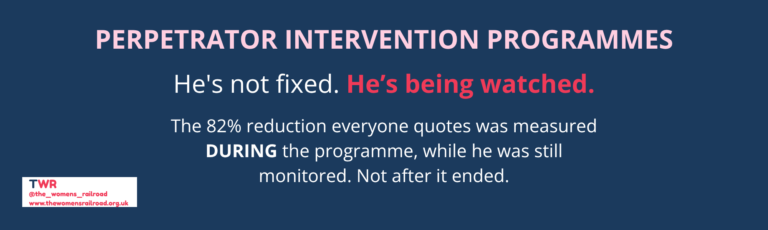
- Read: The Jekyll and Hyde Effect: The Abuser Profile, Perpetrator Intervention Programmes: He’s Not Fixed. He’s Being Watched., Is This Abuse? 5 Types of What Domestic Abuse Can Actually Look Like
- Guides: Keep A Record shows you how to write down what’s happening in your own words. Our original practical guide (Get Money. Get Out. Get Rid.) covers your options for leaving. You can find them on our Get Help page.
The Women’s Railroad is the original practical guide to equip women with the knowledge and options to navigate and leave domestic abuse.