
Written and Published: 28th August 2026
You will have seen the headline figure by now. The Drive Project, the flagship UK model for working with domestic abuse perpetrators, reports that physical abuse fell by 82% among its participants, harassment and stalking by 75%, and controlling behaviour by 73%. It sounds like the kind of number that should end an argument. It does not end this one, and it does not mean what it is often taken to mean.
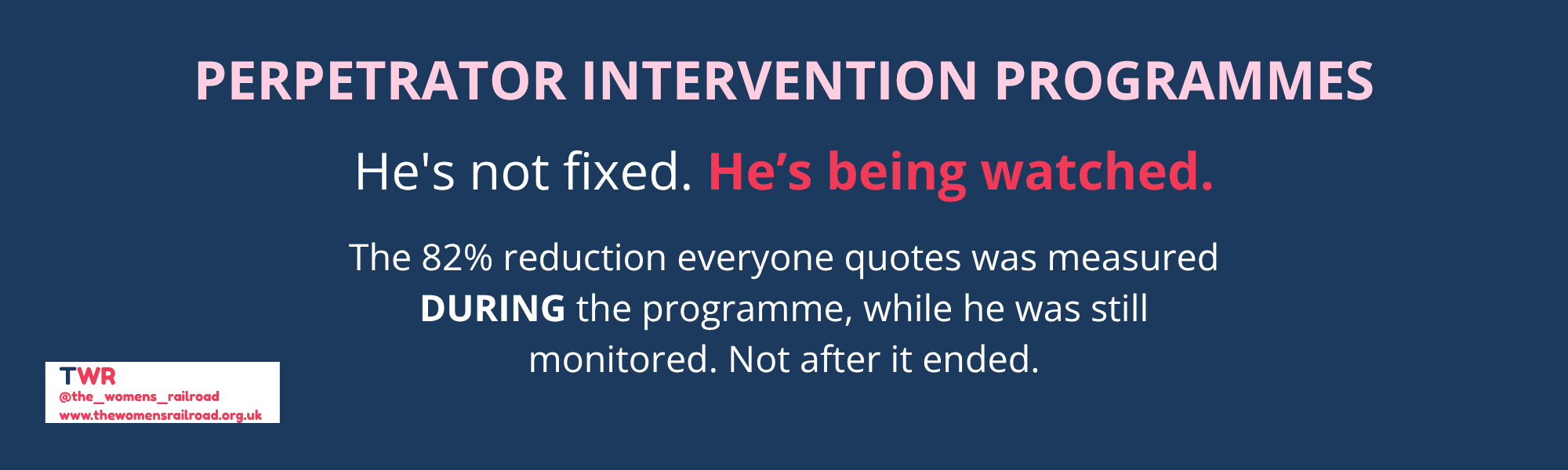
That figure describes behaviour during the intervention itself, comparing a man’s behaviour at intake, midpoint, and completion, while he was still being actively case-managed by an IDVA and monitored by a multi-agency team, typically for around ten months. It is not, by itself, a claim about what happened afterwards.
There is genuine post-intervention data, but it comes from only one of the programme’s three original pilot sites, and it needs to be read carefully rather than quoted as a headline on its own. At that one site, 6% of Drive participants were reported again to MARAC twelve months after finishing the programme, down from higher rates during and before. That sounds like real, lasting change. But the same evaluation found that men who received no Drive intervention at all, just the usual police and IDVA response, showed a similarly sustained reduction over the same twelve months. The researchers’ own conclusion, in their words, is that Drive provides a “modest” reduction in abuse and risk compared with ordinary multi-agency support, not the dramatic, standalone transformation the 82% figure suggests on its own. Being flagged, watched, and supported by a coordinated system appears to reduce abuse to a meaningful degree, whether or not Drive itself is the intervention doing it, and the evaluation’s authors are honest that they cannot fully separate the two.
Two further limitations are worth naming plainly. First, that 12-month figure is drawn from only 64% of the one site’s original participants, over a third had no follow-up data available at all, so even this careful number rests on an incomplete picture. Second, the evaluation’s authors state outright that this data comes from one site only, and that it is “unknown whether the follow-up findings sustain” at the other two pilot locations. In other words: the best available answer to “how long does it last” is that some effect appears to hold for at least a year, at one of three sites, only slightly better than what happens without the programme at all.
There are two further questions that headline figure does not answer, and both matter.
How do these men end up on a programme in the first place?
Drive does not accept self-referrals. Participants are identified through police risk assessment systems or through MARAC, the Multi-Agency Risk Assessment Conference that coordinates the response to the highest-risk domestic abuse cases. In practice, this means Drive works with men who are already known to the system as high-risk, high-harm perpetrators before the programme ever makes contact with them. It is a system-initiated referral, not something the man sought out.
Drive’s own materials are candid about what this means in practice. They describe their caseload as “difficult to engage,” which tells you something real about how these referrals play out on the ground, whatever is or isn’t happening internally for any individual man. Some smaller, local programmes work differently. CARA in Hampshire and Suffolk’s Domestic Abuse Perpetrator Unit, for example, are genuinely voluntary, sometimes offered as an alternative to prosecution or following a police caution. But the headline model, the one behind the most widely quoted statistics, is built on already-flagged, monitored men reached through the system, not on self-referral.
There is no reliable UK-wide figure for what proportion of perpetrators overall enter these programmes voluntarily versus through police, court, or agency referral, and that gap is not for lack of anyone trying. One academic review set out specifically to establish this, contacting all 218 known organisations delivering perpetrator programmes across the UK, prisons, probation services, police and crime commissioners, and charities. Only 21 responded, a 10% response rate. One organisation’s reply, on learning the purpose of the research, was simply that it did not wish to respond. With that few programmes willing to share their own referral data, no reliable national picture could be built, and none appears to have been built since. Individual local authorities sometimes hold this data for their own commissioned programme, obtainable through a Freedom of Information request, but it is not routinely published, and it does not add up to a national answer.
This distinction matters because it changes what the statistic is actually measuring. An 82% reduction in physical abuse among men who are being tracked by police and IDVAs, with professionals checking in on the people around them, is not necessarily the same thing as a reduction in the underlying desire to control or harm, something no evaluation can actually measure. It may simply mean that surveillance and accountability work, at least for as long as they are in place. That is still valuable. It is not the same claim as “these men changed.”
How many go on to abuse someone else?
The clearest general UK research on this question comes from Hester and Westmarland’s 2007 study, which tracked 692 perpetrators reported to a single police force. Half of them were involved in a further reported incident within three years. Of those who reoffended, 18% did so against a new partner rather than the person they had originally been reported for abusing. The abuse did not stop. It moved.
There is also more specific data, from within Drive itself, on men who were already known serial perpetrators before they started the programme. Among that group at the one site with 12-month follow-up data, those who completed Drive still re-appeared at MARAC an average of 0.8 times in the year after finishing, essentially, most were flagged again with a victim roughly once. Men in the control group, who received no Drive intervention, averaged 1.5 times over the same period. So completing the programme roughly halved further flagged contact with a victim among already-serial perpetrators. It did not come close to eliminating it.
This pattern has a name. The College of Policing defines a “serial perpetrator” as someone reported to police for domestic abuse against two or more victims, whether current or former partners or family members. It is a formally recognised category, not a fringe theory, and one older estimate from the Association of Chief Police Officers put the number of serial abusers in contact with police in the UK, at any given time, at around 25,000. That figure is from 2009 and is almost certainly out of date, though whether the true number today is higher or lower is not something we can say with confidence.
On the programmes themselves, the picture is more mixed than the flagship statistics suggest. Dropout rates across UK perpetrator programmes range from 0% to 64%, depending on the programme. One early study found that completing a programme was linked to reductions in abuse of up to 64%, while not completing it was linked to predicting future harm. Put those two facts together and the implication is uncomfortable: a meaningful share of the men referred to these programmes never get anywhere near whatever benefit they might offer, because they simply stop attending.
There is also a gap in the evidence that is worth naming honestly, rather than filling in with a number that sounds authoritative but is not real. There is no publicly available UK statistic tracking how many perpetrators who fully completed a programme went on to seriously reoffend, or to kill a partner, afterwards, and this is not simply a case of nobody having looked hard enough. Perpetrator programme evaluations, including the most detailed one available on Drive, do not track homicide as an outcome measure at all. Domestic Homicide Reviews, the process that examines a death after the fact, are conducted case by case, triggered by an individual killing, and are not cross-referenced against national perpetrator-programme records. The two systems were never built to talk to each other. A homicide involving a former programme participant could, in principle, come to light in an individual review. It would not automatically appear in any national figure, because no such figure exists.
Even the government’s own oversight body is more cautious than individual programme press releases tend to be. HM Inspectorate of Probation states that evaluations of these programmes have reached “varying conclusions, with limited evidence of a significant impact,” and notes that there are no published evaluations at all of the current accredited programmes now in use. That is not a condemnation of the entire model. It is a reminder that the confident, single statistic you see quoted in a press release is rarely the full picture.
Why this matters if you are the one living with it
None of this is an argument against perpetrator work existing. Structured accountability, done properly, alongside police and social services, appears to reduce harm for at least some men, at least for some period of time. That is not nothing.
But it is also not a substitute for your own safety planning, and it should never be treated as one. If you are told that your partner is “on a programme,” that is not the same as being told he has changed, and it is certainly not a reason to lower your own guard, delay your own exit, or assume the risk to you has passed. The evidence base itself, read honestly rather than selectively, does not support that level of confidence. Programmes work at the level of the system, managing a known risk. They do not replace your own decisions about your own safety.
If you are trying to work out whether you are safe, whether he might do this again, whether this is the first time or one of many, that is not a question a perpetrator programme’s success rate can answer for you. It is a question that deserves your own honest assessment, and the resources to act on it if you need to.
The Women’s Railroad provides general information and is not legal advice. Every situation is different. If you are affected by anything in this article, please seek advice from a qualified professional or a domestic abuse service.
Sources:
Hester, M., Ortega-Avila, A.G., Eisenstadt, N. and Walker, S-J. (2025), “Evaluation of the Drive Intervention for High-Harm Domestic Abuse Perpetrators in England and Wales Using a Quasi-Experimental Approach,” Social Sciences, 14(2), 55, the peer-reviewed source for the intake/midpoint/completion figures, the one-site 12-month MARAC follow-up data, the control-group comparison, and the serial-perpetrator re-appearance figures. mdpi.com
Bates, E. et al., “Review of Domestic Violence Perpetrator Programmes in the UK,” the source for the failed UK-wide attempt to establish referral-source data across perpetrator programmes (21 of 218 organisations responded). researchgate.net / elizabethbates.co.uk
Drive Partnership, “The Drive Project model and expansion.” drivepartnership.org.uk
University of Bristol, evaluation of The Drive Project (2016 to 2019). drivepartnership.org.uk / bristol.ac.uk
Drive Partnership, Frequently Asked Questions. driveproject.org.uk
Hester, M. and Westmarland, N. (2007), cited in Serial Domestic Abuse in Wales, Victims & Offenders journal. tandfonline.com
College of Policing (2015), serial perpetrator definition, cited in Victims & Offenders journal. tandfonline.com
HM Inspectorate of Probation, “Domestic abuse” evidence summary. hmiprobation.justiceinspectorates.gov.uk
Frontiers in Sociology (2026), “Unlocking participation: factors associated with attendance on a voluntary domestic abuse perpetrator programme.” frontiersin.org
DV-ACT, “Can Domestic Abuse Perpetrator Programmes Really Change Behaviour?” dvact.org
Respect, “Domestic Abuse Perpetrator Programmes: Do They Work?” respectphoneline.org.uk