
By The Women’s Railroad · Written 28 August 2026
You will have seen the headline figure by now. An evaluation of the Drive Project, the flagship model in England and Wales for working with high-harm domestic abusers, found that the share of men using physical abuse fell by 82%, harassment and stalking by 75%, and jealous and controlling behaviour by 73%. It sounds like the kind of number that should end an argument. It does not end this one, and it does not mean what it is often taken to mean.
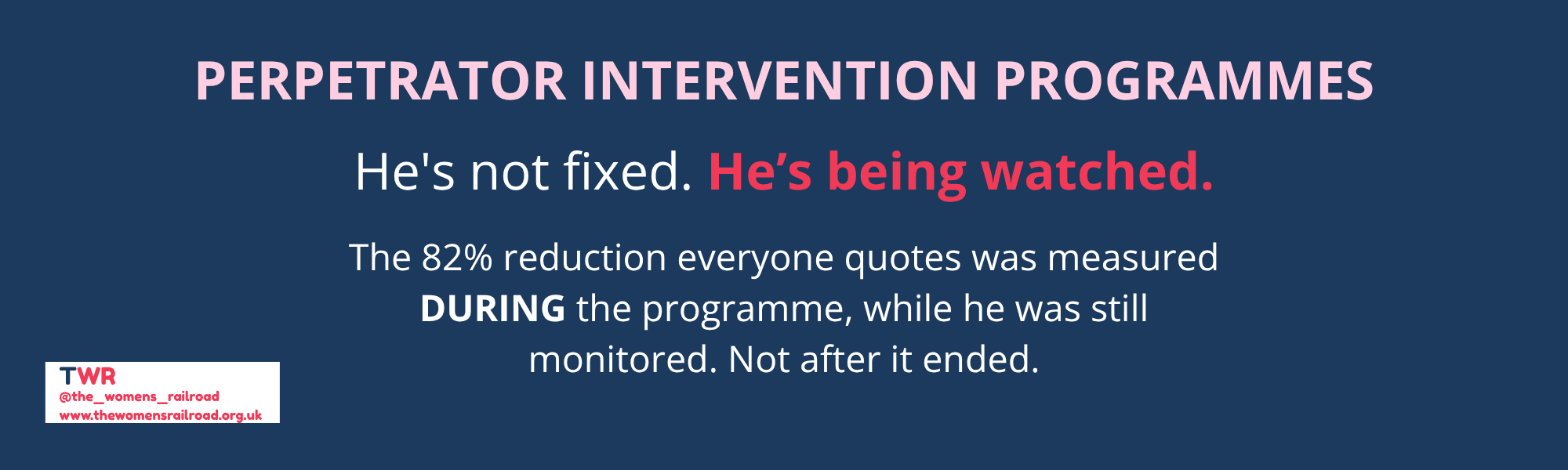
That figure compares the men’s behaviour at the start of the programme with their behaviour at the end, while each man was still being actively managed by a Drive case manager for about ten months. Those case managers work closely with the Independent Domestic Violence Advocates (IDVAs) supporting the victims, as part of a coordinated multi-agency response. There was no control group for that figure, and it is not, by itself, a claim about what happened afterwards.
There is genuine post-programme data, but it comes from only one of the three original pilot sites, and it needs to be read carefully rather than quoted as a headline on its own. At that one site, 6% of Drive participants (12 of the 117 men with follow-up data) re-appeared at MARAC twelve months after finishing the programme. During the programme itself, around 29% had re-appeared. That sounds like real, lasting change. But the same evaluation found that men who received no Drive intervention at all, just the usual MARAC response with IDVA support for victims, showed a similar sustained reduction in abuse. The researchers’ own conclusion is that Drive provides “a modest reduction in domestic abuse perpetration”, not the dramatic, standalone transformation the 82% figure suggests on its own. Being flagged, watched and managed by a coordinated system appears to reduce abuse to a meaningful degree, whether or not Drive itself is doing the work.
Two further limitations are worth naming plainly. First, that twelve-month figure is drawn from only 64% of the Drive participants at that one site, so over a third had no follow-up data available at all. Even this careful number rests on an incomplete picture. Second, the evaluation’s authors state outright that “it is unknown whether the follow-up findings sustain” at the other sites. In other words, the best available answer to “how long does it last” is that some effect appears to hold for at least a year, at one of three sites, only slightly better than what happens without the programme at all.
There are two further questions that the headline figure does not answer, and both matter.
How do these men end up on a programme in the first place?
Drive does not take self-referrals. In its own words, “there is no direct referral route for individuals to self-refer.” Men are identified through police referral criteria or through MARAC, the Multi-Agency Risk Assessment Conference that coordinates the response to the highest-risk domestic abuse cases. Every man in the evaluation had been identified at MARAC as posing high harm and high risk to his victim. In practice, this means Drive works with abusers who are already known to the system as high-risk before the programme ever makes contact with them. It is a system-led referral, not something the man sought out.
Drive’s own evidence to Parliament is candid about what this means. It describes its work as targeting “the most complex and hard to engage serial and repeat cases.” That tells you something real about how these referrals play out on the ground. Some other programmes are voluntary, designed for men who come forward themselves, but the headline model, the one behind the most widely quoted statistics, is built on men who were already flagged and monitored, not on men who asked for help.
There is no reliable UK-wide figure for how many abusers enter these programmes voluntarily and how many are sent by a court, the police or another agency. That gap is not for lack of anyone asking. One 2017 academic review asked organisations delivering these programmes across the UK about their referral routes, including whether men were court-mandated or self-referred. It contacted 218 services: about 134 prisons, 33 probation services and 51 other organisations. Only 21 responded, around a 10% response rate. One organisation replied: “Now I know the source of the research I do not wish to respond.” With so few willing to share their data, no national picture could be built, and we could not find one published since.
This matters because it changes what the statistic is actually measuring. A drop in physical abuse among men who are being tracked by police and professionals, while the people around them are being supported and checked on, is not necessarily the same thing as a drop in the underlying desire to control or harm. It may simply mean that being watched and held to account works, at least for as long as it lasts. That is still valuable. It is not the same claim as “these men changed.”
How many go on to abuse someone else?
One of the clearest UK studies on this is Hester and Westmarland’s 2007 research, which profiled 692 abusers reported to the police in one police force area in England. Half of them were involved in a further incident during the three-year follow-up period. Of those who reoffended, 18% did so against a new partner. The abuse did not stop. It moved.
There is also more specific data from within Drive on men who were already serial abusers before they started. At the one site with follow-up data, Drive participants in this group re-appeared at MARAC with a different victim an average of 0.8 times, compared with 1.5 times for men in the control group, who received the usual multi-agency response. Drive roughly halved repeat appearances among already-serial abusers. It did not come close to stopping them.
This pattern has a name. The College of Policing defines a serial perpetrator as someone reported to the police as having committed or threatened domestic abuse against two or more victims, whether current or former partners or family members. It is a formally recognised category, not a fringe theory. An estimate from the Association of Chief Police Officers in 2009 put the number of serial abusers in contact with the police in Britain at any one time at around 25,000. That figure is now well out of date, and whether the true number today is higher or lower is not something we can say with confidence.
On the programmes themselves, the picture is more mixed than the headline statistics suggest. A 2026 study of a voluntary programme in England reports that dropout across multiple studies ranges from 15% to 58%, and a 2025 paper reports an even wider range, from 0% to 64%. One early US study found that men who completed a programme were around half as likely to re-assault their partner as men who dropped out, though other researchers have questioned that finding, because the men who finish a long programme may already be different from the men who drop out. Dropping out has also been shown to predict further abuse. Put those facts together and the implication is uncomfortable: a meaningful share of the men referred to these programmes never get anywhere near whatever benefit they might offer, because they stop attending.
There is also a gap in the evidence that is worth naming honestly, rather than filling it with a number that sounds authoritative but is not real. The most detailed evaluation of Drive measured abusive behaviour, risk to victims, and repeat appearances at MARAC and with the police. It did not measure deaths. When someone dies in circumstances connected to domestic abuse, a Domestic Abuse Related Death Review is carried out case by case. These were called Domestic Homicide Reviews until 15 September 2026, when the new name came into force in England and Wales and the reviews widened to include deaths by suicide. Published reviews are collected in a Home Office library, but we could not find any national record that links them to whether the abuser had been on a perpetrator programme. A death involving a former programme participant could come to light in an individual review. It would not show up in any national success rate.
Why this matters if you are the one living with it
None of this is an argument against perpetrator work existing. Structured accountability, done properly and alongside police and other agencies, appears to reduce harm for at least some men, for at least some period of time. That is not nothing.
But it is not a substitute for your own safety planning, and it should never be treated as one. If you are told that he is “on a programme,” that is not the same as being told he has changed, and it is not a reason to lower your guard, delay your own exit, or assume the risk to you has passed. The evidence, read honestly rather than selectively, does not support that level of confidence. Programmes work at the level of the system, managing a known risk. They do not replace your own decisions about your own safety.
If you are trying to work out whether you are safe, whether he might do this again, or whether this is the first time or one of many, a programme’s success rate cannot answer that for you. It is a question that deserves your own honest assessment, and the resources to act on it if you need to.
The Women’s Railroad provides general information and is not legal advice. Every situation is different. If you are affected by anything in this article, please seek advice from a qualified professional.
Go deeper
- Dictionary: perpetrator programme, perpetrator, abuser
- Read: Why We Say Abuser, Not Perpetrator, He Says He Didn’t Mean to Hit Me, But How Do I Know This Is a One-Time Thing?, The Cycle of Abuse: Why It Doesn’t Just Stop After One Incident
- Guides: our original practical guide (Get Money. Get Out. Get Rid.) sets out your money, your exit and your next steps. You can find them on our Get Help page.
- Not sure what is happening? Ask Your Burning Questions